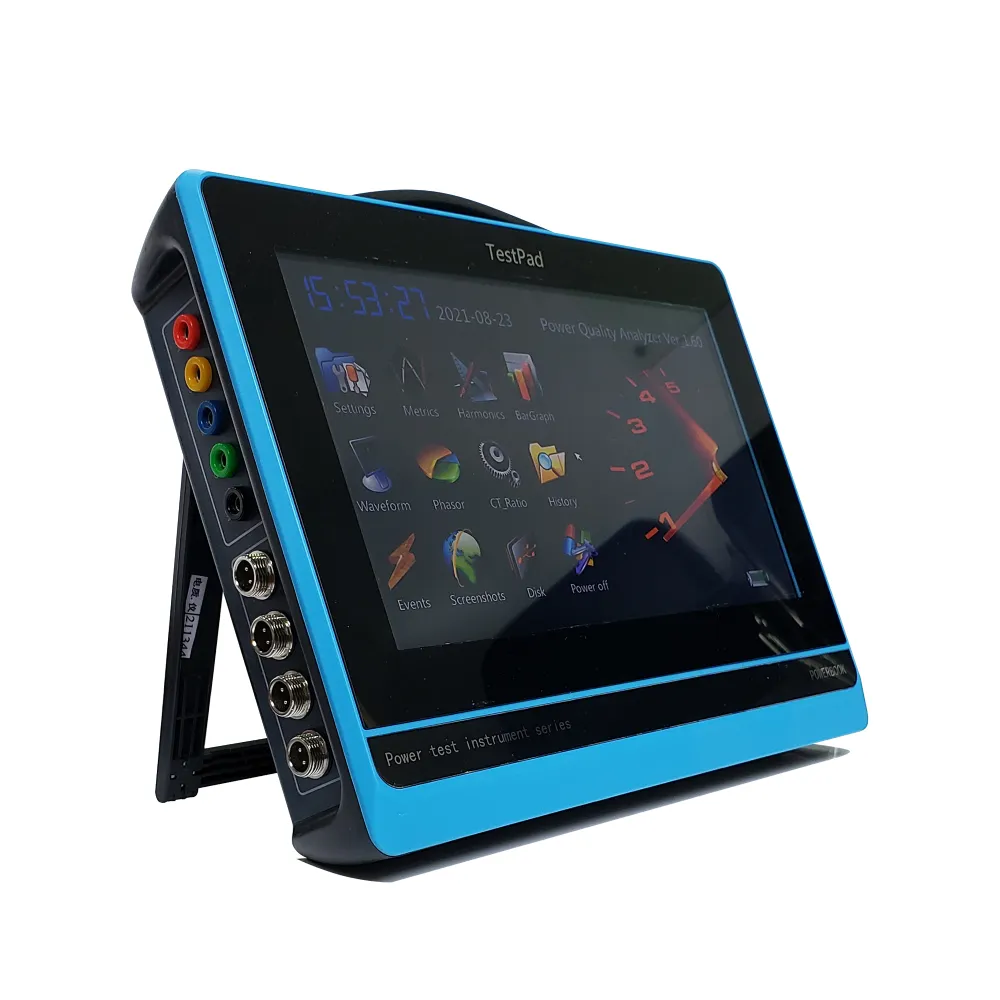
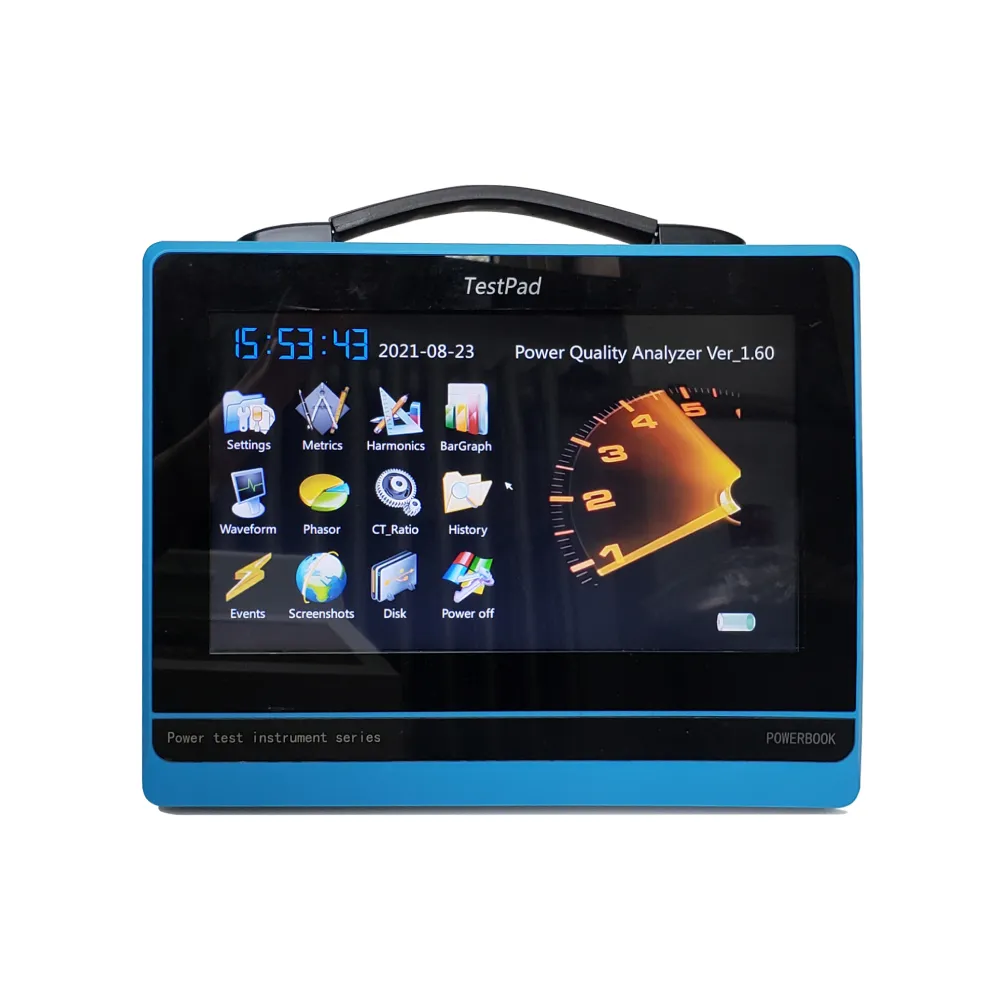
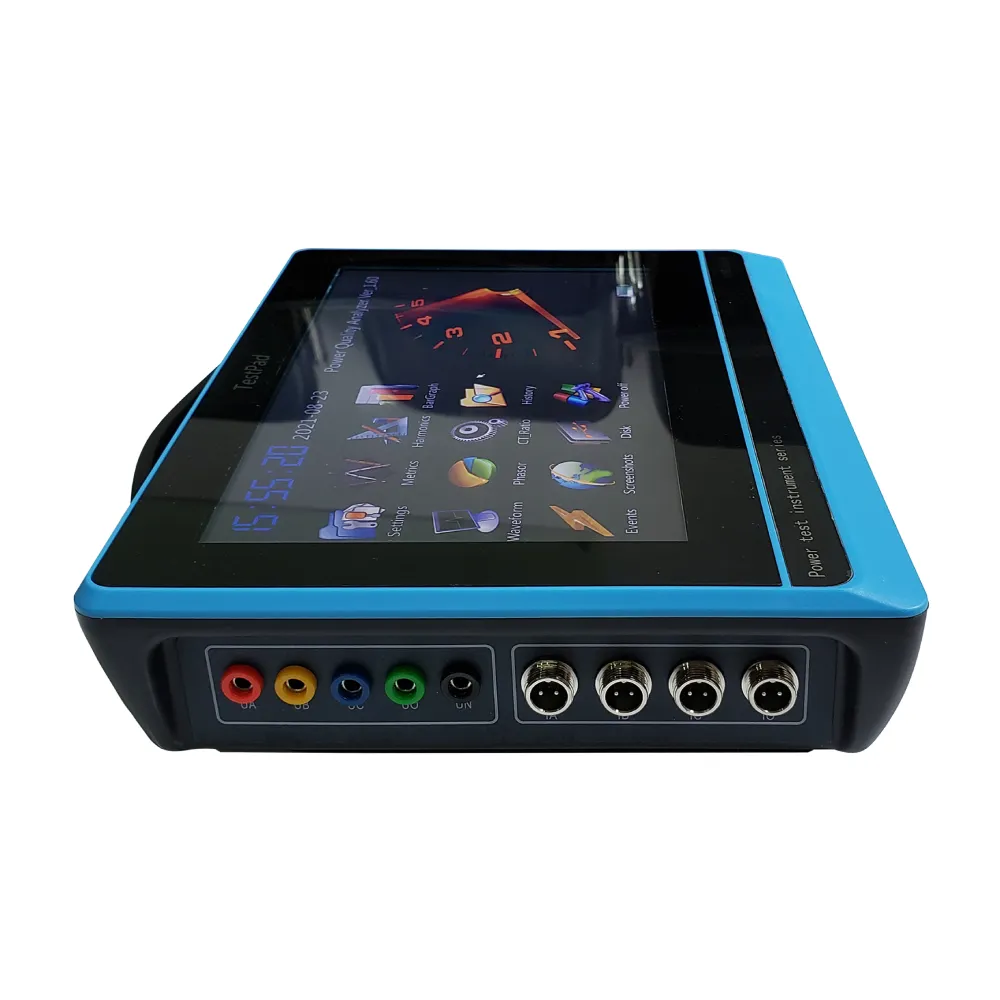
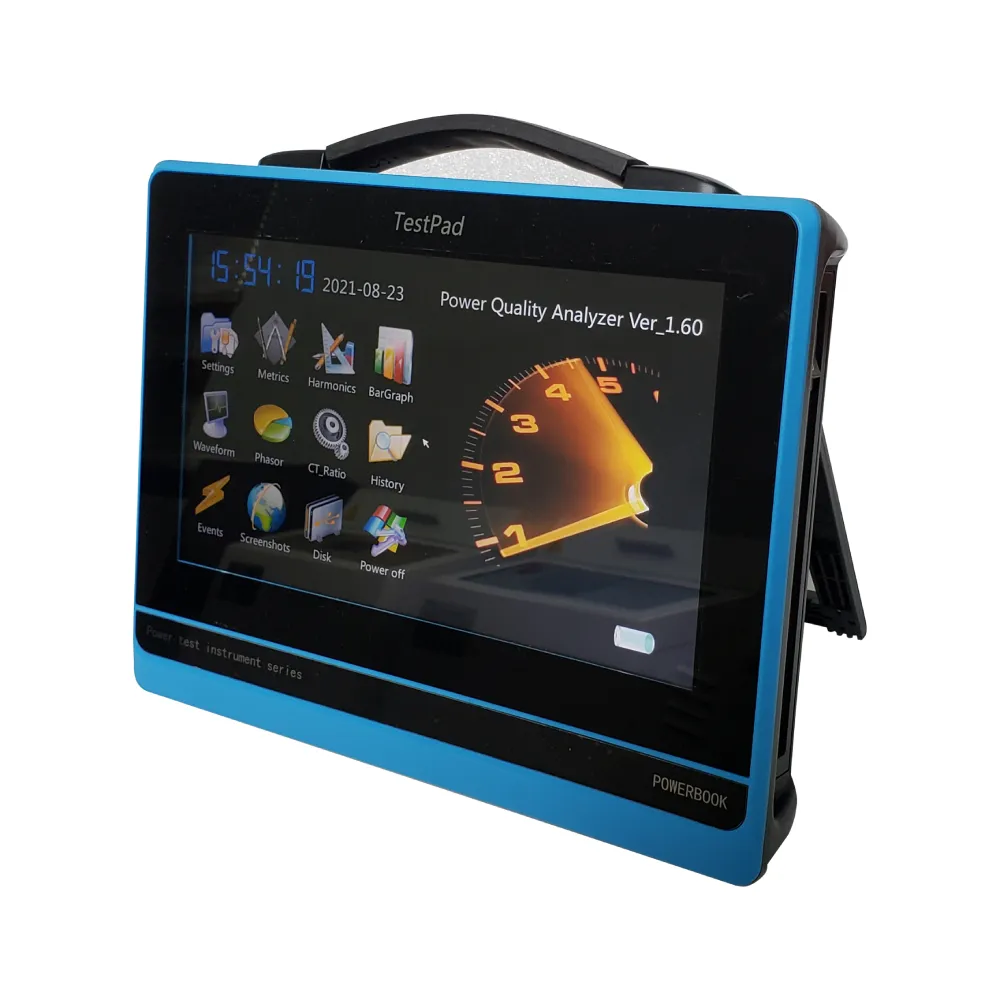
PUSH Electrical PS-DN4 Power Quality Analysis Instrument
A power quality analyzer measures the AC power quality supplied by the public power grid to end users. It features a large screen, mouse-based operation, and built-in large-capacity data storage.
- Categories:Transformer Test
A power quality analyzer measures the AC power quality supplied by the public power grid to end users. It features a large screen, mouse-based operation, and built-in large-capacity data storage.
- 1. Multi-channel measurement: simultaneous measurement of 4 voltage channels and 4 current channels.
2. Electrical parameter measurement: it can measure voltage amplitude, current amplitude, phase, frequency, active power, reactive power, power factor and other parameters at the same time.
3. It can measure voltage and current harmonic content for 2 to 64 orders.
4. It can measure interharmonic content for 0.5 to 31.5 orders (for both voltage and current).
5. It can measure total harmonic distortion (THD) for both voltage and current.
6. Measurable flicker and voltage fluctuations: short-term flicker (PST) and long-term flicker (PLT).
7. It can measure positive-sequence voltage, negative-sequence voltage, zero-sequence voltage, and voltage unbalance factor.
8. It can measure positive-sequence current, negative-sequence current, zero-sequence current, and current unbalance factor.
9. Transient parameter measurement: includes an event recording function for voltage swells and dips. Recording is activated automatically to capture the event occurrence time and the waveforms of five cycles before and after the event.
10. Oscilloscope function: real-time waveform display of voltage and current magnitude and distortion; voltage and current waveforms can be zoomed in on the instrument.
11. Hexagon diagram display: provides vector analysis of the metering circuit and protection device circuit, and helps identify incorrect wiring of the metering device. For three-phase three-wire systems, it can automatically identify 48 wiring methods. It also automatically calculates auxiliary power, which supports users in situations where wiring issues require calculation.
12. Optional large clamp meter: used to measure the transformation ratio and phase angle difference of low-voltage current transformers (CTs).
13. Harmonic content display: histogram format for clear visual presentation.
14. Built-in high-capacity data storage: configurable storage interval from 1 second to 1,000 minutes; continuous storage for more than 18 months at an interval of 1 minute.
15. 10-inch wide-screen color LCD: 1280×800 resolution.
16. Capacitive touch screen operation: similar to tablet computers and smartphones, easy to learn and intuitive to use.
17. Mouse support: suitable for operators with different usage habits.
18. Harmonic compliance indication: when measuring harmonics, it automatically determines whether the content of each harmonic exceeds the limit values according to the national standard, and provides a clear prompt.
19. National standard query for harmonic limits: allows querying permissible values under the national standard.
20. Frequency measurement range: 42.5 Hz to 69 Hz, supporting 50 Hz and 60 Hz power systems.
21. Optional dedicated data analysis and management software: analyzes and processes test results. It helps users understand power quality and periodic load variations at the measurement point, supporting power professionals with appropriate corrective measures. The software plays a key role in power quality understanding and reporting.
22. Analysis software reporting: generates professional power quality analysis reports in accordance with national standard requirements.
23. Screen capture function: any screen display data can be manually saved as image files (pictures).
24. Built-in high-performance lithium-ion battery: automatically enters power-saving mode. The instrument can operate continuously for more than 10 hours without external power, enabling convenient on-site testing.
Number of measurement channels |
Four-channel voltage, four-channel current |
|
Measuring range |
Voltage |
0–900 V |
|
Current |
Small clamp meter: 8 mm aperture, 0–5/25 A (standard configuration) Medium clamp meter: 50 mm aperture, 5–100/500 A (optional) |
|
Phase angle |
0.000–359.999° |
|
Frequency |
42.5–69 Hz |
Resolution |
Voltage |
0.001 V |
|
Current |
0.0001 A |
|
Phase angle |
0.001° |
|
Power |
Active power: 0.01 W; Reactive power: 0.01 Var |
|
Frequency |
0.0001 Hz |
Voltage RMS accuracy |
≤0.1% |
|
Current RMS deviation |
≤0.3% |
|
Phase angle error |
≤0.1° |
|
Power deviation |
≤0.5% |
|
Frequency measurement accuracy |
≤0.01 Hz |
|
Harmonic measurement range |
2–64 orders |
|
Voltage harmonic deviation |
Reference/Typical basis: based on nominal value. When harmonic > 1% of nominal value: ≤1% of reading When harmonic ≤ 1% of nominal value: ≤0.05% of nominal voltage value |
|
Current harmonic deviation |
Reference/Typical basis: based on nominal value. When harmonic > 3% of nominal value: ≤1% of reading + CT accuracy When harmonic ≤ 3% of nominal value: ≤0.05% of the current range |
|
Voltage unbalance accuracy |
≤0.2% |
|
Current unbalance accuracy |
≤0.5% |
|
Short flicker measurement time |
10 minutes |
|
Long flicker measurement time |
2 hours |
|
Flicker measurement deviation |
≤5% |
|
Display screen |
1280×800, color wide-temperature LCD screen |
|
Power plug |
AC 220 V ±15%, 45 Hz–65 Hz |
|
Battery working time |
≥10 hours |
|
Power consumption |
<4 VA |
|
Insulation |
The insulation resistance of the voltage and current input terminals to the chassis is ≥100 MΩ. With a power frequency of 1.5 kV (r.m.s.) between the working power supply input end and the enclosure shell; test duration: 1 minute. |
|
Ambient temperature |
-20°C–50°C |
|
Relative humidity |
0–95% (no condensation) |
|
Physical dimensions |
280 mm×210 mm×58 mm |
|
Weight |
2 kg |
|